

Make / Model Search
OptionsCar reviews - Audi - A5Audi modelsOverviewWe like Choice of Sportback (hatch) or Avant (wagon), resolved chassis, firm but compliant ride, consistency of control surfaces, well-matched plug-in hybrid system, price parity with non-hybrid version, acceptable efficiency Room for improvement Excessive use of piano black trim inside and some secondary materials aren’t plush, adequate but not generous standard specification, desirable options send price north of $100K, battery eats into boot space Audi A5 a proof-of-concept for Audi’s new approach to combustion and hybrid modelsGallery Click to see larger images 19 Jan 2026 By TOM BAKER Overview
MOST European carmakers have been badly jostled in recent years as massive, long-term investments in electrification have delivered mixed payoffs at best, thanks to waxing and waning global EV demand and the effect of aggressive competition from Chinese rivals.
Audi, alongside parent company Volkswagen, is trying to find its way through this turbulence. Among other things, it is looking to lock down a point of difference—not easy when Mercedes-Benz and BMW are trying to do the same and new Chinese ‘luxury’ brands are muscling in.
The four-ringed gang from Ingolstadt have a few ideas in mind. The first is to following Benz into contemporary Formula 1 racing to build up loyalty in younger fans. The second is to leverage deeper relationships with Chinese groups (such as SAIC) to speed the arrival of new EV tech.
What Australians will benefit from sooner is Audi’s decision to make better use of resources it already has—primarily the ageing but competent MQB Evo and PPC vehicle platforms (modernised with new electrics cabling), supplemented by improved hybrid systems courtesy of new battery tech.
Smarter leveraging of existing platforms was an investment BMW enormously benefitted by hedging its bets a decade ago with the Cluster Architecture platform. In a sense, Audi is now following a version of its regional rival’s playbook.
Like the latest Q5 SUV, the new B10 Audi A5 is a proof-of-concept for Audi’s new approach to developing combustion and hybrid models. The underlying Premium Platform Combustion (PPC) platform is a reworking of the well-liked and sophisticated Modular Longitudinal Platform (MLB).
Because of shrinking passenger car demand, the B10 A5 succeeds two cars in the former B9 A4 sedan/wagon and F5 A5 Sportback—both of which used MLB.
Under the skin, many hard points of the PPC-based A5 are familiar from MLB but the electrical architecture has been replaced to run beefier plug-in hybrid (PHEV) or mild hybrid (MHEV) powertrains while powering more sophisticated safety and infotainment requirements.
Most Australian versions of the new A5 are partially electrified, including the entry-level, front-drive 150kW/340Nm 2.0-litre turbo four-cylinder MHEV ($79,900 plus on-road costs) and the hard-charging S5 AWD, with MHEV 270kW/550Nm 3.0-litre turbo V6 (from $114,900 + ORCs).
Latest to arrive are the mid-tier AWD models: a pure-petrol, non-hybrid 200kW/400Nm 2.0T ‘four and the PHEV subject of this test: the A5 e-hybrid, which combines a 185kW/370Nm 2.0T inline-four with a 105kW/350Nm electric motor for peak outputs of 270kW/500Nm.
In a bold move by Audi Australia clearly designed to tempt buyers into the PHEV, which has very low official CO2 emissions of 60g/km, the 200kW petrol and 270kW hybrid are priced identically from $89,900 + ORCs, despite the PHEV also having more standard equipment.
Why? A cynic would note that every sale of the PHEV helps Audi’s emissions profile under Australia’s punitive NVES laws while every sale of the non-hybrid hinders it. The Volkswagen Group isn’t a charity.
Standard fare from the base A5 model up includes real leather seating (powered and heated up front), a 14.5-inch OLED touchscreen and 11.9-inch Virtual Cockpit, wireless CarPlay/Android Auto, in-car connectivity, three-zone climate, 360-degree camera and full keyless entry.
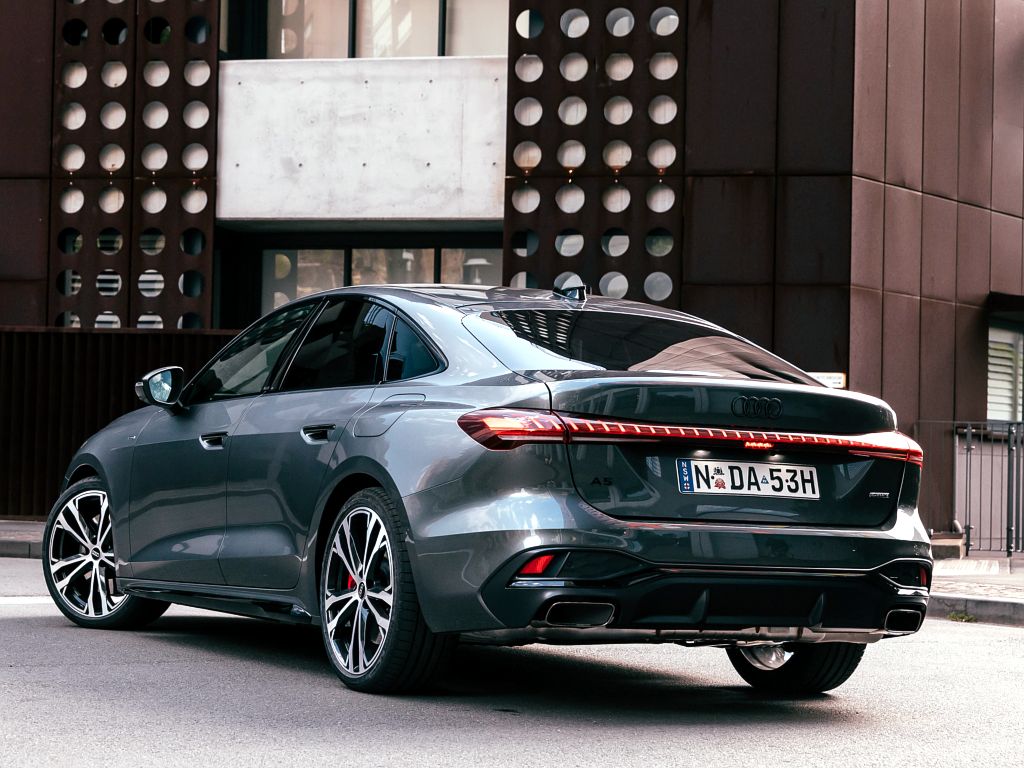
Atop the S line interior pack added by the 200kW petrol, the 270kW e-hybrid adds gratis spec’ in the form of a black exterior styling package, 20-inch wheels, red brake callipers, a passive sports suspension, privacy glass and the ability to start the air conditioning from the phone app.
Still, despite a price that brushes up to $100K driveaway in standard form, some options are necessary to make the A5 e-hybrid feel special.
In our view these include premium paint ($2100-3400), front seat ventilation ($2200), and the Premium Package ($4900) which adds a head-up display, acoustic glass, high-power USB charging, and a high-end Bang & Olufsen stereo with 19 speakers.
With the A4 sedan dead, the standard A5 body style is the useful Sportback shape which has a large rear hatch. We appreciate that Audi Australia persists in offering a handsome and practical Avant (wagon) version of all AWD A5/S5 trims for a $3000 premium.
Audi Australia claims the A5 e-hybrid can travel 93km on electric power (using its 20.7kWh nickel manganese cobalt battery, chargeable on AC power only at up to 11kW) while there is a 56-litre fuel tank (that demands 95-octane premium petrol) for extended touring.
Buyers can add a five-year/75,000km service plan at the time of purchase for $3360. A five-year/unlimited kilometre warranty applies to the vehicle while the hybrid battery is covered for eight years/160,000km.
Driving impressions
From a dynamic perspective, the A5 e-hybrid is mature and enjoyable to drive. Atop a polished chassis—which showcases a firm but compliant ride and engaging handling—sits a PHEV system comprised of an appealing petrol engine from a Golf GTI and a powerful, torquey electric motor.
While Audi (and other Volkswagen Group brands) have sold PHEVs before in Australia, the A5 e-hybrid is a giant leap forward in terms of driver appeal. PHEVs of all types have tended to feel janky and compromised in the past, but the combination here is slick, even somewhat desirable.
That is a good thing because the nature of Australia’s new vehicle emissions regime makes it very likely we will see many more Volkswagen Group PHEVs sold here in place of traditional petrol or diesel engines. At least they’re now decent to drive.
Aside from the ride and handling, the core of the appeal of the A5 e-hybrid powertrain is the happy marriage of the complex components. In EV mode, the 105kW/350Nm offers enough punch alone before the clean-revving 185kW/370Nm ‘four agreeably blends into the mix.
Either or both the power sources can drive the A5 through its quick-shifting seven-speed dual-clutch automatic transmission. The ‘Quattro ultra’ AWD system uses an electro-hydraulically actuated clutch in the propshaft and around 50 per cent of torque can be sent to the rear.
This is a powerful PHEV, and the decision to opt for a conventional internal combustion engine (rather than, say, simply a generator) means the A5 e-hybrid isn’t as efficient as some Chinese hybrids from BYD or Geely, but the Audi is fundamentally more appealing to drive.
As well as the sweet powertrain combination, which makes the A5 e-hybrid feel refreshingly normal on the open road, there is an inherent depth and solidity to the way this midsize car drives that feels intrinsically grounded in Audi’s traditional strengths.
In part, that is down to Audi engineers refusing to abandon old-school traits like consistent weighting and response of key control surfaces but it is also a product of masterful tuning of the PHEV’s passively damped sport suspension, which delivers a well-judged ride quality.
While the combination of the slightly lowered ride and low-profile 20-inch alloy wheels in 245/35 R20 tyres all-round would normally have us feeling a little trepidation, there is surprising compliance and bump absorption to be found here as well as excellent body control.
The A5 is also a sweet steerer. Audi says the engine has been moved a bit further rearward to improve weight balance and front-end response; either way, crisp and zealous turn-in and even some actual road feel is fed to the driver via the leather wheel.
While the Quattro system in this specification of A5 is not permanently rear-biased (unlike the S5), the software tune has clearly been geared to punch torque rearward while cornering enthusiastically as light oversteer can be coaxed out of the Audi. It’s entertaining to drive!
It is also not frustrating to drive, as Audi Australia has opted to have some of the A5’s safety technologies default to ‘off’ for our market—including audible speed monitoring and attention warning. As for lane-keep and adaptive cruise control, we found them well-tuned.
Our test took place in and around the Sydney region in the wagon. As well as devouring a few great roads we also called the A5 into assist with a house move, where the generous length of the Avant’s cargo space helped even if its (official) 345-litre boot sounds small.
That modest number is a product of the boot floor being raised relative to the window-line to accommodate the PHEV battery, but the cargo area isn’t as small as it sounds. The lack of a spare wheel and tyre is a concern if you like to do extensive touring, however.
Moving inside, it is fair to say that new gen’ Audi interiors have been downgraded from ‘great’ to merely ‘good’. While there has been considerable shrieking online about poorer material quality (some of which is justified), overall, the A5 still has an acceptable cabin.
Audi has not abandoned the important stuff: the leather sports seats are still very comfortable and supportive for long drives; the steering wheel rim and stalks continue to feel expensive; and there remain some physical controls for things like volume and changing gear.
The problem is that Audi’s old penchant for abundant, real metals, knurled switchgear and tidily integrated tech have been thrown out in favour of more prominent screens, touch-sensitive controls, cheaper hard plastics lower down, and way too much piano black across the dash.
Unusually, Audi has publicly acknowledged that its new-age interior push has gone too far. Expect to see the facelift pulled back; in the interim, late-2026 examples will return to some physical shortcut controls on their steering wheel spokes in a concession to buyers.
Still: the operation of the 14.5-inch central screen, with its fixed climate control bar, is intuitive enough (especially as most owners will choose to run wireless Apple CarPlay/Android Auto), though the level of customisation available in the digital instruments has been reduced.
Stereo quality with the optional B&O hi-fi system was crisp, clear and loud…though we found ourselves needing to turn it up a touch to mask a quality flaw in our tester, which was a slight rattle in the driver’s door.
We would skip the fixed-pane, dimmable glass roof ($4990), which adds weight, light and heat into the cabin and can’t be opened—a bummer.
Back seat space represents another finding of ‘good, not great’. Maybe that’s OK: we suspect the A5 Sportback or Avant will probably be the sporty, second car sitting next to a pragmatic SUV in owner garages. Two adults do fit back there but legroom and headroom are not massive.
Viewed in the realistic context that accepts that sedans and wagons are now more likely to be an indulgent car purchase rather than a family car that must appeal to everybody, the A5 e-hybrid has considerable appeal.
While the 200kW non-hybrid petrol is ultimately the more straightforward choice, for buyers interested in an electrified option, perhaps with the ability to charge at home, the plug-in Audi A5 is a charming and well-executed option for the well-heeled buyer.  |
OptionsClick to share
|



 Alfa Romeo
 Abarth
 Audi
Audi Aston Martin
 BMW
BMW Bentley
 Ferrari
 Chevrolet
 Ford
Ford Fiat
Fiat GWM
GWM Foton
Foton Hyundai
 Honda
Honda Jaguar
 Isuzu
Isuzu Kia
Kia Jeep
Jeep Land Rover
 Lamborghini
 Maserati
 Lexus
Lexus McLaren
 Mazda
Mazda MG
MG Mercedes-Benz
 Mitsubishi
 Mini
Mini Peugeot
 Nissan
 Ram
Ram Porsche
 Rolls-Royce
 Smart
Smart Skoda
Skoda Suzuki
 Subaru
 Toyota
 Tesla
Tesla Volvo
Volvo Volkswagen
 Zeekr
Zeekr

Connect with us


Facebook Twitter Instagram